Yaws (Endemic treponematoses)
Key facts
- Yaws is a chronic disfiguring and debilitating childhood infectious disease.
- Yaws affects skin, bone and cartilage
- Yaws is currently endemic in 9 African countries
- 50 -80% of the people affected are under 15 years of age
- Peak occurrence is in children aged 6 – 10 years
- A single dose of the antibiotic azithromycin can completely cure Yaws
- Yaws is targeted for eradication by 2030
- Mass treatment campaigns (also called total community treatment, TCT) and Total Targeted Treatment (TTT) are underway in affected populations
Yaws is a poverty-related, infectious skin disease that affects mainly children below 15 years of age (with a peak between 6 and 10 years) in warm, rural, tropical areas in Africa, the Western Pacific Islands and Southeast Asia. About 75% of people affected by Yaws are children. It occurs in overcrowded communities, with limited access to basic amenities such as water and sanitation, and limited health care. It is said that “Yaws begins where the road ends”.
 Yaws mainly affects the skin but can also involve the bone and cartilage. Early detection and treatment can avoid gross disfigurement and disability which occur in about 10% of cases.
As of 2024, Yaws is currently endemic in 16 countries worldwide, while 82 countries, areas and territories are considered previously endemic.
The Yaws epidemiologic situation in 2024 in the Africa region is as follows:
- 9 countries currently endemic (Group A): Benin, Cameroon, Central African Republic, Côte d’Ivoire, Ghana, Liberia, Congo, Democratic Rep. Congo, Togo
- 26 countries previously endemic current status unknown (Group B)
- 12 countries no previous history (Group C): Algeria, Botswana, Cabo Verde, Eritrea, Lesotho, Mauritania, Mauritius, Namibia, Sao Tome and Principe, Eswatini, Seychelles, South Africa.
The disease presents in three stages, the first and second of which can be treated. The third stage can involve changes to the bones in many parts of the body.
- Primary Yaws (1-3 months from infection) is characterized by ulcers and papillomas.
- In the secondary stage (3 months to 2 years of infection), symptoms include bone swelling and plantar keratosis.
- Tertiary Yaws (up to 10 years after infection) is marked by cartilage destruction and bone malformations.
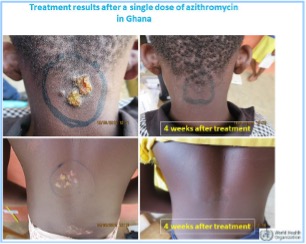 Yaws can be cured by Azithromycin or benzathine penicillin:
- Azithromycin (single oral dose) at 30 mg/kg (maximum 2 g) is the preferred treatment.
- Benzathine penicillin (single intramuscular dose) 0.6 million units (children under 10 years of age) and 1.2 million units (persons over 10 years of age) may be used in case of failure of azithromycin treatment, or for patients who have a contraindication for azithromycin.
The follow up should be done 4 weeks after antibiotic treatment. Complete clinical healing will be observed in over 95% of cases. Any individual with presumed treatment failure requires macrolide resistance testing and treatment with benzathine penicillin. Sometimes, exploring alternative diagnoses might be considered.
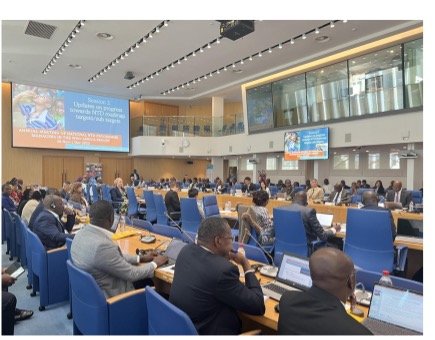
WHO's work on Yaws eradication involves:
- strategy development to guide countries in planning and implementing Yaws eradication activities; in recent years, WHO has published the following guidance documents and training materials:
- Eradication of Yaws: surveillance, monitoring and evaluation. A manual for Yaws eradication programme managers
- Eradication of Yaws: a guide for programme managers
- Eradication of Yaws: procedures for verification and certification of interruption of transmission
- Training material to help health workers and community volunteers to identify the disease;
- supporting endemic countries to implement Yaws eradication strategy including WHO-secured donation of 153 million tablets of azithromycin.
- standardized tools to guide data collection, reporting and monitoring.
- strengthening collaboration and coordination among partners and stakeholders ;
advocacy and partnerships
Promoting the integrated approach: WHO recommends integrating Yaws eradication activities with NTD programmes and Skin NTDs (active surveillance). In this regard, WHO published a strategic framework for integrated control and management of skin-related neglected tropical diseases.
