Retour volontaire de refugies Burundais

Retour volontaire de refugies Burundais

Ils sont 70 anciens réfugiés burundais qui ont volontairement décidé de rentrer chez eux. La cérémonie devant marquer leur accueil a eu lieu ce jour 14 août 2017 sur le pont de passage entre la République Démocratique du Congo et le Burundi à Gatumba. On notait également la présence d’officiels des deux pays frères et plusieurs fonctionnaires des Nations-Unies et de quelques ONG.
 

Taking stock of lessons learnt from the Cholera outbreak response in Tanzania

Participants engaged in the planning and preparatory session prior to the AAR
The United Republic of Tanzania is battling an outbreak of Cholera that has since August 2015 affected 26,046 people and claimed 410 lives. Ending the outbreak and preventing its spread beyond Tanzania's borders is a high priority for WHO. To that end, WHO and partners support a well-coordinated multisectoral response through the National Cholera Task Force which plans, coordinates and support subnational authorities.

Seventy seven percent (77%) of children 12 – 23 months in Nigeria did not receive all routine immunization – Survey findings

Dr Rachel Seruyange making a speech on behalf of the WHO Country Representative Dr Wondimagegenehu Alemu

Abuja, 10 August, 2017 - A major survey finding from 2016 Multiple Indicators Cluster Survey/National Immunization Survey Coverage (MICS/NICS) reveals that seventy seven percent (77%) of children aged 12 – 23 months in Nigeria have not received all the routine vaccinations as recommended by the national EPI schedule while forty percent (40%) of children in this age group did not receive any vaccinations putting  it  to be far below the ninety percent (90%) national target that has been set by the country.

The United Republic of Tanzania launches the National Action Plan for Health Security

_
“Building resilience, strengthening global health security!” was the theme during the historical launch of the Tanzania National Action Plan for Health Security (NAPHS). The journey towards the NAPHS started after completion of the Joint External Evaluation (JEE) in February 2016. This year, Tanzania made giant strides in strengthening the implementation of IHR core capacities.

Reaching key populations to prevent the spread of disease in Ethiopia

 Reaching key populations to prevent the spread of disease in Ethiopia
In Ethiopia, thousands of pilgrims flock to holy water sites for spiritual cleansing and physical healing. People often drink the holy water and perform ceremonial cleansing for their bodies or those of their loved ones. But there is a risk that these sites can be contaminated with bacteria that cause acute watery diarrhea (AWD) or other waterborne diseases as open defecation is a common practice in open fields close to holy water sites. To protect the pilgrims, WHO is working with the Ethiopian Orthodox Church, Ministry of Health, UNICEF, OCHA and other partners to ensure that water safety and latrine access is improved around holy water sites.

Cross River sets agenda with first state health summit

Dr Alemu (with microphone) addressing participants at the Summit
The first Cross River Summit anchored on Human Resource for Health (HRH) on Primary Health Care (PHC) revitalization with the theme ‘Translating Health Policies and Plans into Action” was conducted in Calabar, the state capital on 7-8 August, 2017.

World Breastfeeding Week launched in Harare

March through Highfield to raise awareness

Harare: 3 Aug. 2017 - World Breastfeeding week was launched in Highfield, Harare under the theme Sustaining Breastfeeding Together. The event, which was attended by the Highfield community of nursing mothers, UN agencies, and other players in child health and nutrition, aimed to mobilise stakeholders to work together to strengthen existing partnerships and forge new ways to invest in, and support breastfeeding for a more sustainable future. The launch comes amid calls by stakeholders to improve the exclusive breastfeeding rates in Zimbabwe.

Building a results-driven WHO workplan in Tanzania

_

Dar es Salaam, 7- 8 August 2017: In WHO, accountability for results and resources are reflected in the workplans. A “good” workplan must be robust, results-driven and meaningful for the country and the organization. Results-driven planning reflects the vision articulated in the Transformation Agenda which aims at facilitating the emergence of “the WHO that the staff and stakeholders want”.

WHO supports the development of the Seychelles’ Introduction Plan for Rotavirus and Pneumococcal Vaccines
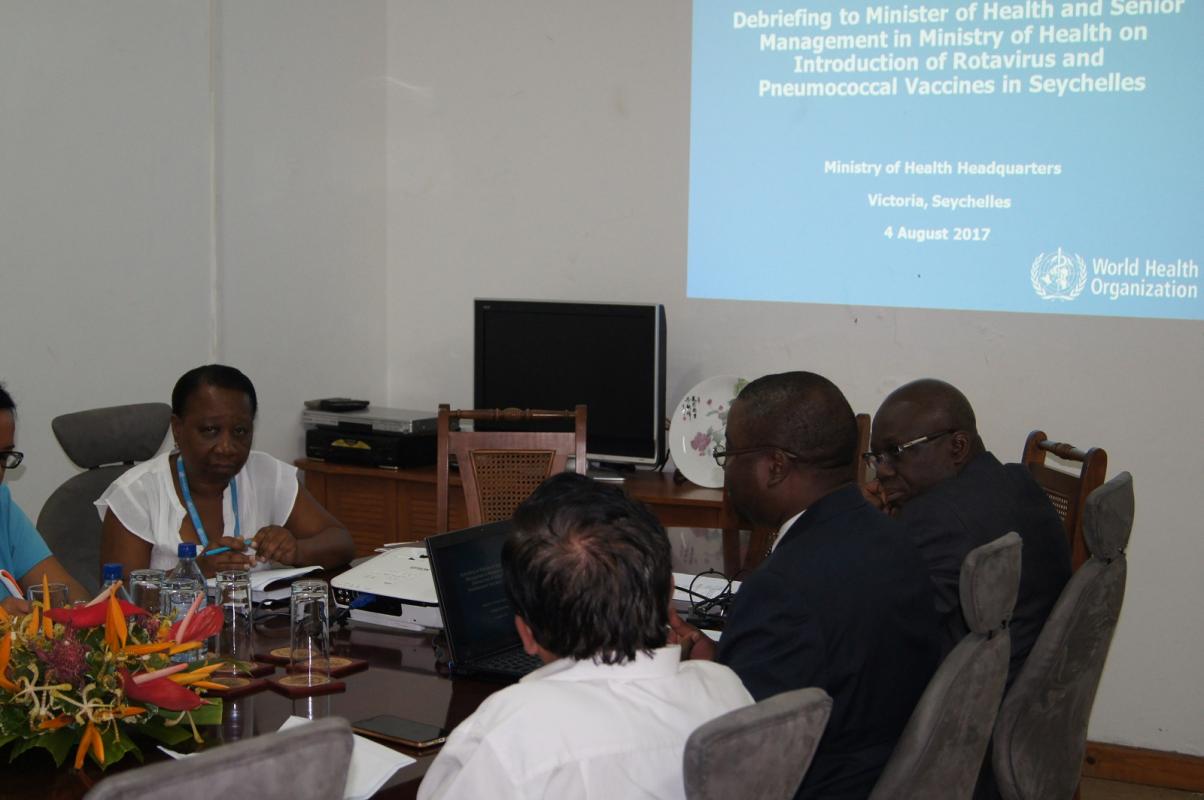
WHO Consultants discussing country’s readiness to introduce the Rotavirus vaccine and PCV
The Seychelles is well on track with the preparation to introduce two new vaccines into its routine immunisation programme. This was confirmed by the two WHO Consultants who were in the country between the 24th July and 4th August 2017 to assess the country’s readiness to introduce the Rotavirus vaccine and the Pneumococcal Conjugate vaccine (PCV). WHO Consultants Dr. Mumba Mutale and Dr. Amos Petu presented their findings of their assessment at a debriefing session with the Minister of Health Jean-Paul Adam, other high level officials of the Ministry of Health and the WHO Liaison Officer for Seychelles Dr. Bhupinder Aulakh.