I can, we can win the battle against cancer
 A woman who discovers a lump in her breast is immediately assailed by a feeling of anxiety and panic. That is how I felt the evening I accidentally discovered a lump in my right breast. My heart was beating wildly. I wondered whether it was a cancer, a cyst or a benign tumour.
WHO supports proposed sugar-sweetened beverages tax in South Africa

The World Health Organization supports the consideration of Government of South Africa of introduction of a tax on sugar-sweetened beverages (SSB) to help reduce excessive sugar intake. This is one of interventions proposed in the Strategy for the prevention and control of obesity in South Africa 2015-2020. WHO has supported introduction of such taxes since it was proposed by the National Treasury in August 2016.
WHO capitalizes on comparative advantage to deepen support for Nigeria’s health agenda

Abuja, 03 February 2017-In 2016 - Nigeria recorded disease outbreaks such as Lassa fever, poliomyelitis, cholera and measles. Equally, the scale of humanitarian crisis in the northeast was uniquely different due to the nature of insurgency in the region with 6.9 million people in dire need of humanitarian assistance.
WHO in South Sudan: Build, Equip and Deploy to Save the Lives of Mothers
 With 789 deaths per 100 000 live births, South Sudan is among 40 countries with the highest maternal mortality (death) rates in the world.
Nigerian Crisis Situation Report, Issue number 22, 21 -27 January 2017

The measles vaccination campaign, conducted in partnership with Nigerian government, WHO and several non-governmental organizations, also included vitamin A supplement for all children under five to boost their immunity and as well deworming tablets. Under the mass measles vaccination campaign across Borno state, 2,608,090 children have been vaccinated out of target of total 3,113,620 children of age group 6 months to 10 years in 25 LGAs with 84% coverage.
Liberia Launches 5 Year Mental Health Policy and Strategic Plan

Monrovia 28th January, 2017 - Sinoe County is the second least densely populated county in Liberia with a population of 102,391. The County has one hospital and 34 clinics with a total of two Medical Doctors, 18 Physician Assistants and 67 Nurses. 41% of the population of the county live more than 5km away from any health facility. Some communities are hard to reach or inaccessible due to heavy forest cover and rivers which include Japuken community which has no health facility.
Uganda intensifies battle against HIV/AIDS through the launch and dissemination of consolidated guidelines

The Director General of Health services in Ministry of Health (MoH), Uganda, Prof. Anthony Mbonye recently launched the National HIV Testing services policy and implementation guidelines that would enable Uganda reduce by half the number of HIV infected individuals and at the same time increase those who know their status.
Historic Commitment from African Heads of State to Advance Immunization in Africa
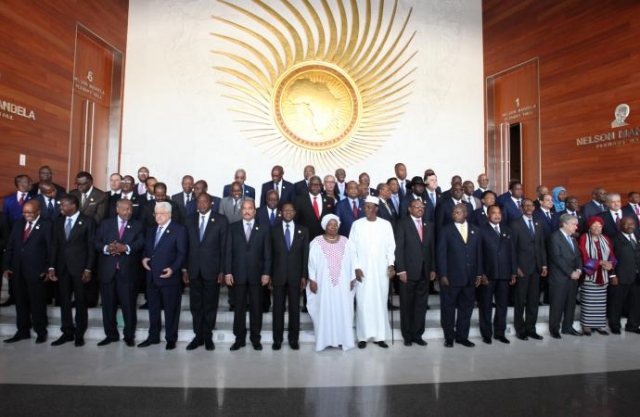
31 January 2017, Addis Ababa, Ethiopia – Today, Heads of State from across Africa adopted a Declaration on Universal Access to Immunization in Africa, in which they endorsed the Addis Declaration on Immunization, a historic and timely pledge to ensure that everyone in Africa – regardless of who they are or where they live – receives the full benefits of immunization. The endorsement was issued during the 28th African Union (AU) Summit in Addis Ababa, Ethiopia.
Borno State weekly epidemiological bulletin, 09 - 15 January

Alerts are based on 7 weekly reportable diseases in the national IDSR reporting format (IDSR 002) and 8 additional diseases/health events of public health importance in the IDP camps and IDP hosting areas.
Borno State Weekly Epidemiological Bulletin, 09 - 15 January
Ethiopia bans medicalization of female genital mutilation (FGM)
As part of its endeavors to ensure the health and wellbeing of its people, including women and children, Ethiopia has committed to eliminate female genital mutilation (FGM) and early marriage by 2025. In line with this, the Ministry of Health banned medicalization of FGM in all public and private medical facilities in the country. As per the circular passed on 4 January 2017, medical personnel who engage in any form of FGM in medical facilities will be subjected to legal action.