Launch of emergency vaccination campaigns on the DR Congo and Angola border
Brazzaville, 22 June 2016 – As the yellow fever outbreak in Angola and Democratic Republic of the Congo continues, the World Health Organization will launch emergency pre-emptive vaccination campaigns on the DR Congo, Angola border and the city of Kinshasa in the DR Congo to halt the epidemic and prevent the risk of further international spread.
World Blood Donor Day Launched in Liberia

Monrovia 22 June, 2016: Ministry of Health Liberia launched the World Blood donor Day on 21stJune under the theme “Blood connects us all” and a slogan ‘save a life donate blood’. This theme highlights the dimension of sharing and the connection between blood donors and patients. Access to safe blood and blood products is in line with the Investment plan to building a resilient health system.
WHO South Sudan Participated in an Emergency Drill Exercise to Ensure Proper Incident Response

Juba, 20 June 2016 - On 18 June 2016, residents of the Naivasha Residential Compound (the security approved compound for UN international staff) conducted emergency drill exercises to test plans and promote awareness of staff roles and responsibilities during an incident scenario. The simulation was held at the Naivasha Residential Compound.
The simulation consisted of a “scheduled exercise” held on the morning of June 18, 2016, to bring together the internationally recruited staff from WHO, UNICEF, UNDP and WFP.
The objective of the exercise was:
Yellow fever global vaccine stockpile in emergencies
 When a major outbreak of yellow fever hits, countries need to access vaccine supplies urgently for rapid vaccination campaigns to control spread of the disease.
Botswana Launches Treat All Strategy

Already a proven leader in HIV/AIDS management and control, Botswana once again blazes a new trail for the rest of the world to follow. On 3rd June 2016, His Excellency the President of the Republic of Botswana Lt. Gen. Dr Seretse Khama Ian Khama launched Botswana’s Treat All Strategy. The Strategy eloquently promotes Universal Health Coverage and ensures that all who test positive get treatment no matter their viral load or CD count.
Scaling up the expanded programme on immunization in conflict affected states

Juba, 17 June 2016 - WHO South Sudan in partnership with the MOH, Core group, UNICEF and Bill and Melinda Gates Foundation (BMGF) conducted a three-day refresher training for field supervisors and assistants from the three conflict affected states, namely Jonglei, Unity and Upper Nile, from 15 to 17 June 2016 at Juba Regency Hotel.
Uganda Prioritizes response to Sickle Cell Disease

Kampala, 17th June 2016 - Northern Uganda has the highest prevalence of Sickle cell trait and malaria in the country standing at 18.6% and (63%) respectively .This was revealed in a Sickle cell survey done in 2014 by the Ministry of Health (MoH) with support from Makerere College of Health Sciences and Cincinnati Children’s hospital. The study further revealed that East-Central regions come second with a sickle cell prevalence of 16.7% and malaria at 56%.
Dr Tigest Ketsela Mengestu presents letter of Credence to Swaziland Government
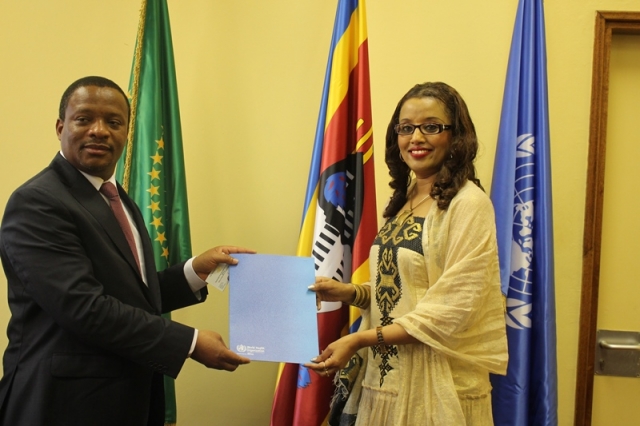
16 June 2016, Mbabane: Dr Tigest Ketsela Mengestu presented her letter of credence to the Honourable Minister of Foreign Affairs and International Relations, Senator Chief Mgwagwa Gamedze at his offices in Mbabane on the 16th of June 2016. This followed her confirmation and appointment as the Head of Mission and Representative to the WHO Swaziland country office. Her appointment is with effect from the 15th of April 2016.
Health challenges and needs in South Sudan
Dr. Abdulmumini Usman, World Health Organization`s Country Representative in South Sudan explains key health challenges, WHO`s current activities and what specific needs could be met with further funding in the future.
World Blood Donor Day-Nigeria requires innovative strategies for sufficient and safe blood supply.

Abuja, 14 June 2016 - The Honourable Minister of State for Health, Dr Osagie Ehanire says that access to safe blood transfusion requires innovative strategies to ensure safe and sufficient blood supply, to achieve 100% voluntary blood donation and to ensure 100% quality-assured testing of donated blood. There is also a need to optimize blood usage for patient health, develop quality systems in the transfusion chain, strengthen the workforce, keep pace with new developments and build effective partnerships for safe blood.