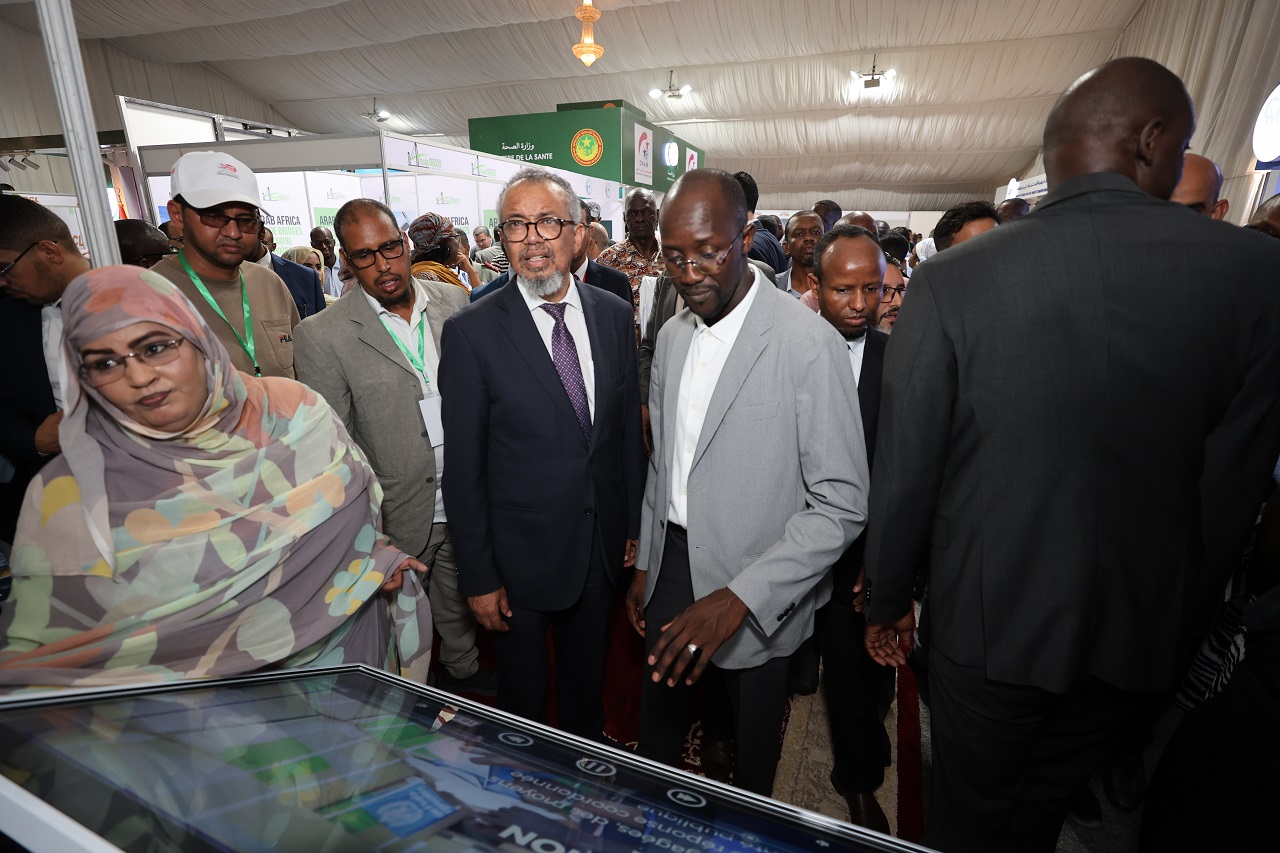
Nouakchott, Mauritania, 14 July 2026 – WHO Director-General, Dr Tedros Adhanom Ghebreyesus, concluded a visit to Mauritania today to reaffirm WHO's support for the country's efforts to position health as a strategic investment for economic development, regional stability and human security. During the visit, Dr Tedros met with His Excellency President Mohamed Ould Cheikh El Ghazouani and participated in the Regional Health Invest Forum, which culminated in the adoption of the Nouakchott Declaration on enhancing local production and investment in health.
During his audience with President Ghazouani, Dr Tedros commended Mauritania's leadership in promoting health as a national development priority and discussed opportunities to strengthen primary health care, universal health coverage, health security and sustainable health financing. He reaffirmed WHO's commitment to supporting the Government's ambitious health reforms and its vision of positioning Mauritania as a regional hub for health investment and cooperation.
The visit coincided with the Regional Health Invest Forum, co-organized by the Ministry of Health of Mauritania, the Islamic Centre for Development of Trade (ICDT), WHO, the Islamic Development Bank and the African Development Bank. Hosted under the leadership of His Excellency Thiam Tidjani, Minister of Health of Mauritania, the Forum brought together government leaders, development partners, financial institutions and private sector stakeholders to accelerate investment in health and pharmaceutical development across Africa and Member States of the Organisation of Islamic Cooperation (OIC).
A major outcome of the Forum was the adoption of the Nouakchott Declaration, through which participating health ministers, senior officials and partners committed to advancing local pharmaceutical production, enhancing regulatory cooperation, promoting investment in health and mobilizing sustainable financing.
During the Forum, WHO Mauritania and the Mauritanian Investment Promotion Agency (APIM) signed a memorandum of understanding to strengthen collaboration between the health and investment sectors. The partnership will support the identification of investment opportunities, promote responsible private sector engagement and facilitate the development of investment-ready health projects aligned with national priorities and the Sustainable Development Goals.
The Forum also featured a high-level ministerial roundtable on the Health Impact Investment Platform (HIIP), bringing together ministers of health, development finance institutions and partners to discuss how to accelerate investment in primary health care through sustainable financing. Participants exchanged experiences in developing investment-ready health projects and highlighted the importance of targeted technical assistance, such as that provided through the Platform, to build a strong pipeline of bankable investments.
The roundtable also highlighted Mauritania's engagement in the Health Impact Investment Platform, a joint initiative led by WHO and multilateral development partners. Mauritania is currently developing a proposal to strengthen primary health care, which is expected to be reviewed by the HIIP Steering Committee in October 2026.
At the Forum, Dr Tedros joined national authorities, health ministers of OIC Member States and international partners to discuss how to translate political commitment into sustainable financing for stronger, more resilient health systems. The Forum served as a platform for promoting and operationalizing investment in health infrastructure, medicines and vaccines, regional value chains and public-private partnerships that can expand access to quality health services.
“Mauritania is demonstrating that investing in health is investing in people, resilience and prosperity,” said Dr Tedros. “I commend Mauritania for bringing together governments, development banks, industry leaders and investors, showing how strategic partnerships can transform health priorities into sustainable investments that benefit both current and future generations.”
During the visit, the Director-General visited health facilities representing different levels of the Mauritanian health system, including a primary health care centre and the National Cardiology Centre. These visits highlighted the country's efforts to strengthen integrated service delivery across the continuum of care, from community-based prevention and health promotion to specialized referral services - while expanding equitable access to quality care and addressing the growing burden of communicable and noncommunicable diseases.
Throughout the visit, the WHO Director-General reaffirmed WHO's commitment to working with the Government of Mauritania and partners to improve maternal and child health, enhance access to care for noncommunicable diseases and strengthen digital health, in line with priorities discussed with Minister Tidjani.
The visit also underscored the Organization's determination to work with governments, development banks, investors and the private sector to position health as a catalyst for inclusive economic growth, regional stability and sustainable development.