BRIDGE-Access
Bundibugyo Response for Improving Diagnostic Global Equitable Access
An initiative of WHO and Africa CDC


BRIDGE-Access (Bundibugyo Response for Improving Diagnostic Global Equitable Access) is a multi-partner platform lead by the Africa CDC and WHO with support from Unitaid, generating independent, comparative performance data on diagnostic products and accelerating access to high-quality and affordable diagnostics against Bundibugyo virus disease (BVD). BRIDGE-Access was stood up in the weeks following the Public Health Emergency of International Concern (PHEIC) declaration on 17 May 2026 (https://www.who.int/news/item/17-05-2026-epidemic-of-ebola-disease-in-the-democratic-republic-of-the-congo-and-uganda-determined-a-public-health-emergency-of-international-concern), and sits alongside the PARTNERS and EBO-PEP trials as part of a coordinated, multi-partner research response to BVD on diagnostics, treatment, and prevention respectively. BRIDGE was able to be launched quickly through leveraging the continental incident management support team, established following the declaration of the PHEIC by Africa CDC and WHO (https://khub.africacdc.org/records/resource/africa-cdc-who-launch-of-the-continental-preparedness-and-response-plan-for-ebola), WHO’s as well as the existing Diagnostics Workstream of the interim Medical Counter Measures Network (i-MCM-Net) (https://www.who.int/initiatives/i-mcm-net).
Now open: Second Expression of Interest for Ebola Diagnostics
BRIDGE-Access is inviting diagnostic test manufacturers to apply to participate in an independent evaluation of Ebola (Bundibugyo virus disease) tests.
This second call focuses on tests designed for primary healthcare and community settings — portable, easy-to-use tools that don’t require a laboratory, bringing testing closer to patients and communities who need it most.
For applicants to the first EOI (June 2026): the second EOI follows the same evaluation framework but targets highly decentralized molecular tests and “next-generation” RDTs that could improve BDBV testing performance. You only need to reapply if you have significantly updated the design of a previously submitted product, have new performance data relevant to BDBV, or wish to submit a new product that meets this EOI’s eligibility criteria.
- Who can apply: Legal manufacturers of in vitro diagnostic (IVD) tests, including molecular (nucleic acid-based) and antigen-based tests.
- What’s involved: Selected manufacturers will have their tests independently evaluated, with BRIDGE-Access covering the cost of the evaluation, including purchase and shipping of test products.
- Deadline: Submissions must be received by 6 December 2026, 23h59 CEST.
- Questions: Email bridge-access [at] who.int (subject: EOI-2%20EBOLA%20EVALUATION%20NOV2026) (bridge-access[at]who[dot]int) and rfp.bi [at] finddx.org (subject: EOI-2%20EBOLA%20EVALUATION%20NOV2026) (rfp[dot]bi[at]finddx[dot]org) with the subject line “EOI-2 EBOLA EVALUATION NOV2026.”
Download the full EOI document for complete eligibility criteria, application requirements, and instructions on how to apply:
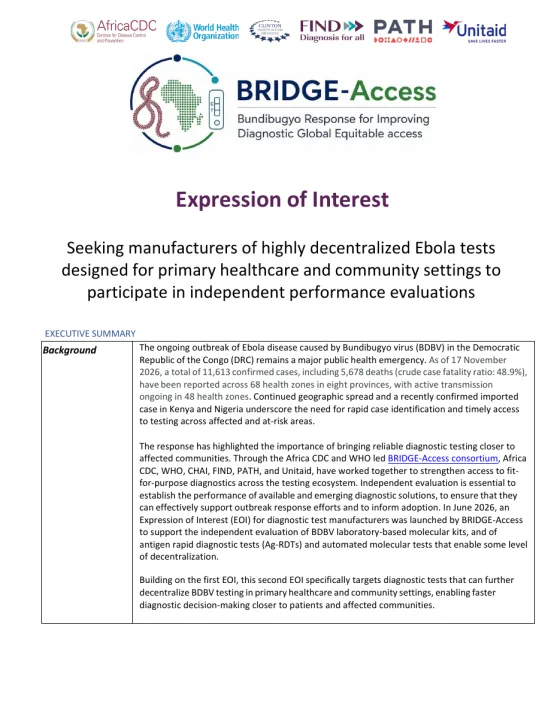
Expression of Interest: Seeking manufacturers of highly decentralized Ebola tests designed for primary healthcare and community settings to participate in independent performance evaluations
PDF, 625 KB
BRIDGE-Access is led by Africa CDC and WHO, in partnership with CHAI, FIND, PATH, and with support from Unitaid.
Advancing access to reliable diagnostics across Africa
Early detection of outbreaks depends on access to accurate and reliable diagnostic tests. Yet across Africa, access to these tools remains a challenge, particularly for diseases that require specialised testing.
Through the Africa Collaborative Initiative to Advance Diagnostics (AfCAD), Africa CDC works with partners to improve access to quality-assured diagnostics and support their use across the continent.
BRIDGE-Access, a joint initiative of Africa CDC and the World Health Organization (WHO), contributes to this work. The initiative focuses on evaluating diagnostic tests for Ebola virus disease caused by Bundibugyo virus, generating the evidence needed to guide their use in African countries.
The findings will also inform the work of the Africa CDC Diagnostics Advisory Committee (DAC), which reviews scientific evidence and provides technical recommendations on diagnostic technologies. These recommendations can help national and regional regulatory authorities make informed decisions about the registration and introduction of diagnostic tests.
Through this collaboration, Africa CDC and WHO aim to help African countries access reliable diagnostic tools and improve their ability to detect and respond to outbreaks.
Purpose
When Bundibugyo virus disease (BVD) emerged, no diagnostic test had been validated against this Ebola virus species. However, the diagnostic pipeline was not empty. Several manufacturers already had pan-Ebola tests, while others were able to adapt their tests to detect Bundibugyo virus within days.
© WHO / Josua Mulala Raymond
The key challenge therefore was not just to develop new tests in response to the outbreak, but to understand how well the available tests were performing, under what conditions they could be used, and how easily they could be accessed. Rapidly assessing their performance, availability, and access conditions was essential to inform an effective diagnostic response. Rather than wait for the outbreak to end to find out which tests actually work, partners took a different approach: stand up a rigorous, independent evaluation during the response itself.
Since then, diagnostics have earned WHO Emergency Use Listing (EUL) (see here for the most recent information on listed tests: https://extranet.who.int/prequal/sites/default/files/document_files/EUL%20BDBV_List%20of%20BDBV%20IVDs_1.pdf). The EUL listing is a critical step that has given countries trusted, quality-assured tools to deploy quickly. BRIDGE-Access is a separate and complementary effort that seeks to further promote equity in the generation of diagnostic evidence by facilitating access to the clinical specimens and evaluation resources needed to assess performance. By making these resources more broadly and equitably accessible, BRIDGE-Access can help create more equitable conditions for manufacturers and developers, including newer and emerging manufacturers, regardless of their geographic location or existing networks. This helps ensure that the generation of comparative performance evidence is not unduly influenced by differences in access to specimens, infrastructure, partnerships, or resources, while providing countries with a broader and more representative evidence base to inform diagnostic decisions and to select a product that makes the most sense for their context
Approach
The evaluation is guided by what affected countries actually need to make diagnostic decisions on the ground, and spans three product categories: near-point-of-care/LC-NAAT molecular platforms, antigen rapid diagnostic tests (Ag-RDTs), and lab-based PCR kits.
Manufacturers entered the pipeline through an initial open call for Expressions of Interest (EOI), which closed on 11 June 2026, giving any qualified manufacturer, anywhere, the chance to have their product considered for evaluation. In the initial EOI round, 83 products were submitted, with 39 selected from 33 manufacturers across 12 countries spanning all WHO regions – Canada, China, Egypt, Germany, India, Japan, Nigeria, Senegal, South Africa, the Republic of Korea, the United Kingdom, and the United States demonstrating the strong commitment to geographic diversity. The selected 39 products include 7 near point-of-care (nPOC)/ low-complexity nucleic acid amplification tests (LC NAATs), 11 antigen rapid diagnostic tests (RDTs), and 20 lab-based PCR tests.
Selected products by category
- near point-of-care (nPOC)/ low-complexity nucleic acid amplification tests (LC NAATs)
- antigen rapid diagnostic tests (RDTs)
- lab-based PCR tests
The Partnership
BRIDGE-Access is co-led by Africa CDC and WHO, with support from Unitaid. The evaluation itself is delivered together with NGO partners PATH, CHAI, and FIND, and carried out at partner laboratories and Collaborating Centres:
© WHO / Natalie Ridgard
- INRB (Institut National de Recherche Biomédicale), Kinshasa, DRC: Retrospective evaluation
- Laboratoire Rodolphe Merieux, INRB Goma: Prospective field evaluation
- CPHL (Central Public Health Laboratories), Uganda: Retrospective evaluation
- Charité (Berlin, Germany): Analytical evaluation
- BNITM (Bernhard Nocht Institute for Tropical Medicine, Hamburg, Germany): Analytical evaluation
- UKHSA (UK Health Security Agency): Analytical evaluation
- HUG (Geneva University Hospitals, Switzerland): Analytical evaluation
- Oxford University (United Kingdom): Analytical evaluation
Other partner laboratories with BSL-4 capacity are welcome to join the partnership and can reach out to bridgeaccess [at] who.int (bridgeaccess[at]who[dot]int)
Partners


Manufacturer Access Commitments
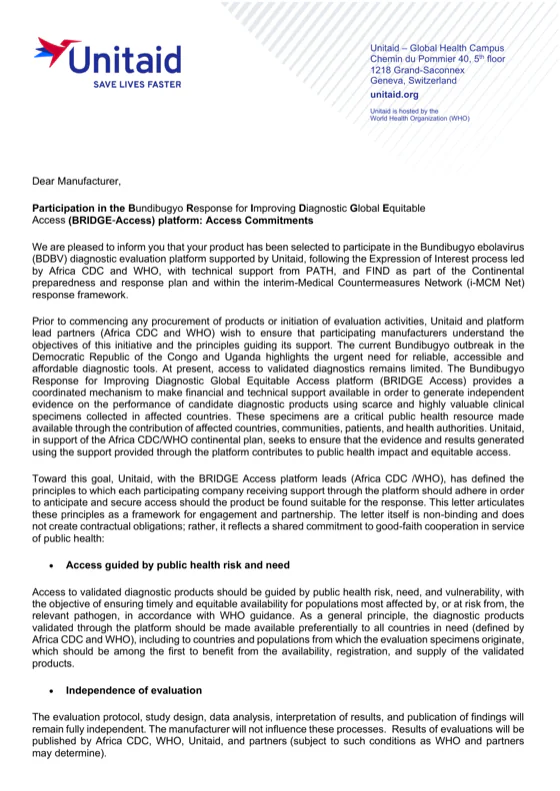
Before any product enters evaluation, manufacturers must sign an Access Commitments letter — a framework, defined by Unitaid together with Africa CDC and WHO, that ties participation to concrete, good-faith obligations, including:
- Preferential access for affected countries, including the countries and populations from which the evaluation specimens originate
- Fair and transparent pricing, preferably at a reasonable margin over the cost of goods for endemic regions
- Manufacturing under an ISO 13485-certified quality system (or equivalent)
- Full scientific independence — manufacturers have no influence over the evaluation's protocol, data analysis, or results
- Continued efforts to support sustained supply and technical support beyond the immediate outbreak response
This letter and the commitments within are made public in the interests of transparency.
Next Steps
BRIDGE-Access is designed to move at the pace this outbreak demands, with additional phases planned to keep generating quality science fast enough to make a difference in the current response. Protocols and results will be shared as they are developed and become available.
© WHO / Josua Mulala Raymond
BRIDGE-Access also has a role beyond Bundibugyo virus disease. Many of the selected platforms are multiplex diagnostic platforms capable of detecting multiple viral haemorrhagic fever pathogens. Additional laboratory-based assessments will evaluate performance across a broader range of pathogens and outbreak scenarios, increasing the long-term value of this investment by ensuring validated platforms can also contribute to future epidemic preparedness.
Protocols
Study protocols will be published here as they are finalized and approved.
- Retrospective clinical evaluation protocol (DRC): To be published once finalized
- Analytical evaluation protocol: To be published once finalized
- Prospective field evaluation protocol: To be published once finalized
Results
- Retrospective clinical evaluation (DRC): Results forthcoming
- Retrospective clinical evaluation (Uganda): Results forthcoming
- Analytical evaluation: To be shared once available
- Prospective field evaluation: To be shared once available