Tanzania launches the introduction of two new vaccines: Rotarix and PCV 13 with a call to ensure all children are vaccinated

On 6th December, 2012, Tanzania historically became the second country, in sub-Saharan Africa to launch the introduction of two new vaccines simultaneously in the routine immunization schedule. The national launch took place in Dar es Salaam and was officiated by the First Lady of the United Republic of Tanzania, Mama Salma Kikwete. Others also present to witness the launch were the Regional Commissioner for Dar es Salaam, Hon. Said Meck Saddick; the Minister for Health and Social Welfare, Hon. Dr. Hussein Mwinyi; the Chairman of the GAVI Alliance, Mr.
WHO Evidence-Informed Policy Network Meeting Calls for Improvement of Human Health through Research
Brazzaville, 6 December 2012 - The World Health Organization (WHO) has called upon countries of the WHO African Region to use research to promote knowledge and strengthen health action in order to improve human health.
Zambia hosts regional meeting for mapping of unmet country needs to accelerate the implementation of the International Health Regulations (2005) in the Africa Region
Lusaka, 04 December 2012 -- The World Health Organization Regional Office for Africa (WHO/AFRO) in collaboration with WHO Global Capacities, Alert and Response has organized a regional meeting for mapping of unmet country needs to accelerate the implementation of the International Health Regulations (2005) in the African Region. Since the IHR (2005) came into force in 2007, many countries in the WHO African Region have developed IHR implementation plans and improved their surveillance and response capacities.
A review of the Work of World Health Organization in the African Region
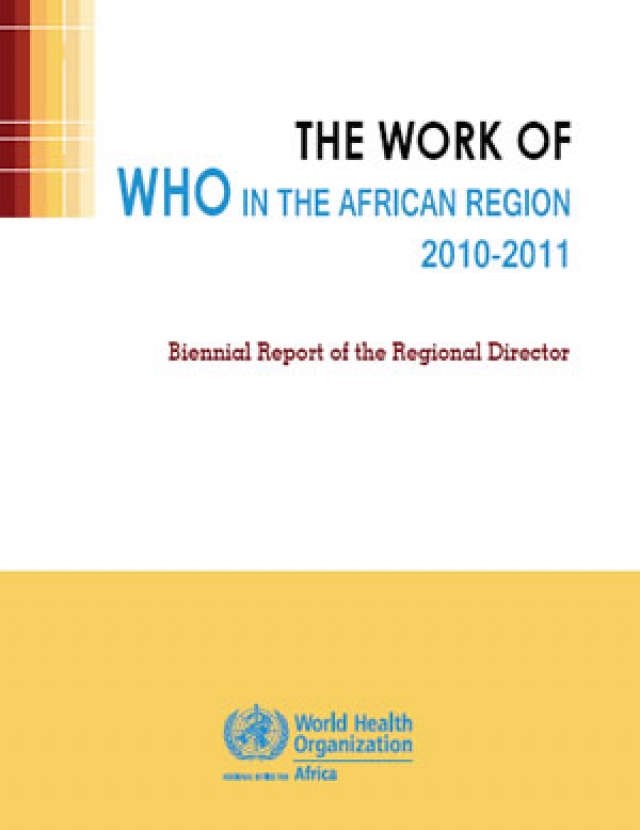 Luanda, 22 November 2012 -- A report on the work of the World Health Organization (WHO) in the African Region has been presented by its Regional Director for Africa, Dr Luis Sambo, to the 62nd session of the WHO Regional Committee for Africa taking place in Luanda, Angola.
Towards more effective National Health Information Systems in the WHO African Region
Brazzaville, 21 November 2012 -- Health information is a key component of national health systems. Better Health Information Systems means a healthier public.
What is a Health Information System? It is the collection, organization, use and transmission of quality and reliable information on human health that is used to shape policy, make decisions, and monitor health status and trends. In the World Health Organization (WHO) African Region, national health information systems have limited capacity to produce good quality and timely information.
Dr Sambo Proposes Actions to Strengthen Health Systems in the WHO African Region
Luanda, 21 November 2012 -- The World Health Organization (WHO) Regional Director for Africa, Dr Luis Sambo, has proposed a set of actions which African countries should prioritize to strengthen their national health systems, drawing resources from the large number of existing global health initiatives (GHIs) operating in the Region. Global Health Initiatives are programmes targeted at specific diseases and are intended to bring additional resources to the health efforts of countries.
Building core capacities to prevent international spread of disease
Luanda, 21 November 2012 -- On 15 June 2007, the new International Health Regulations (IHR) came into force. These regulations, agreed by all African countries, were designed to help countries and WHO to work together to detect and control the international spread of serious public health threats, like infectious disease.
The IHR aim to quickly identify an outbreak or any other public health threat, including chemical and radiological hazards that could have an international impact, so that a fast and effective response can be organized.
Realizing the Right to Health in the WHO African Region
Luanda, 20 November 2012 -- All Member States of the World Health Organization (WHO) in the African Region are signatories to international and human rights treaties in which the right to health is enshrined. Yet, experts say, the health status of millions of people in the region remains poor.
Why is this the case and how can the situation be improved?
WHO proposes Strategy for Disaster Risk Management in the African Region
Brazzaville, 20 November 2012 -- The World Health Organization (WHO) is proposing a strategy to address the negative health and economic impact of natural and man-made disasters frequently experienced in the African Region.
The strategy, developed by the WHO Regional Office for Africa (WHO/AFRO), was today presented by the WHO Regional Director for Africa, Dr Luis Sambo, to the 62nd session of the WHO Regional Committee for Africa which is taking place in Luanda, Angola.
WHO updates Health Promotion Strategy for the African Region
Luanda, 20 November 2012 -- The World Health Organization (WHO) has updated the Health Promotion (HP) strategy to address the growing burden of preventable public health conditions in the WHO African Region.
The updated strategy, which covers a period of 10 years, is being discussed at the Sixty-second ses-sion of the WHO Regional Committee for Africa which is taking place from 19-23 November in Luanda, Angola. The Strategy highlights specific roles and responsibilities for Member States, WHO and other partners for an effective response.