Health in Africa in 2000-2001: a balance sheet
Harare-- The World Health Organization (WHO) and its 46 Member States in the African Region focused on the broad determinants of health and disease during the 2000-2001 biennium and were thus better able to bring about long-term and sustainable improvements in the status of its people.
This is contained in the Biennial (2000-2001) Report of the WHO Regional Director for Africa, Dr Ebrahim M. Samba, to be released at the 52nd session of the WHO Regional Committee for Africa (RC52) scheduled for 8 -12 October Harare, Zimbabwe.
Female Functional Literacy
Female Functional Literacy and Inter Sectoral Action In furtherance of its objective of supporting the vulnerable rural poor communities to improve their health status and livelihoods, WHO supported the Department of Community Development in November to organize a joint programme for the commissioning of a corn-mill and a two-day health workshop for women leaders in the Hodzo cluster of villages in the Volta region.
Video: The Mothers of Africa
Women's health is recognized as a human rights issue and should be promoted and defended as such. Women in Africa represent slightly over 50% of the continent's human resources and so women's health has huge implications for the Region's development. Focusing in particular on the unacceptably high level of maternal mortality in sub-Saharan Africa, the report calls for a fundamental rethinking of approaches to improving women's health informed by an understanding of the sociocultural determinants that are so important in shaping it.
WHO information note: Guidance for immunization programmes in the African Region in the context of Ebola virus disease
As a public health emergency of international concern (PHEIC), the Ebola virus disease outbreak in West Africa has drawn huge global attention and response.
Numerous queries about immunization services and the risks they present have been raised. Tragically in some areas, there are reports of increased vaccine-preventable deaths, such as measles. In this context, practical guidance on immunization is needed.
The specific purpose of this document is to assist countries to:
Regional Consultation on roles and responsibilities of WHO and civil society organizations in prevention and control of NCDs
Regional Consultation on the roles and responsibilities of WHO and civil society organizations in the prevention and control of noncommunicable diseases in the African Region
Intercontinental Hotel, Balaclava, Mauritius, 17-18 October 2016
Tuberculosis
Key facts
- Tuberculosis (TB) is one of the top 10 causes of death worldwide.
- In 2015, 10.4 million people fell ill with TB and 1.8 million died from the disease (including 0.4 million among people with HIV).
WHO Pledges To Work For Success Of NEPAD
New York -- The World Health Organization has pledged to intensify its efforts to ensure the success of the New Partnership for Africa's Development (NEPAD), the new vision for Africa's future initiated by several African Presidents and subsequently adopted as the continent's main development framework at summit of African Heads of State in July 2001.
African Public Health Leaders Unite to End Preventable Deaths and Improve Health of Women, Children and Adolescents by 2030
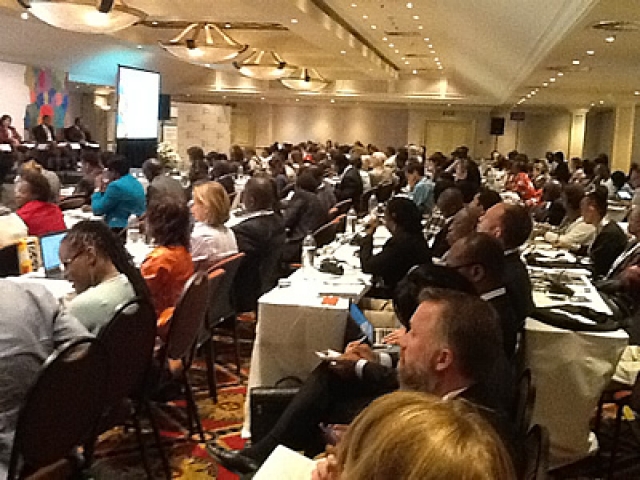
Regional Stakeholders Convene to Shape Global Strategy for Women’s, Children’s, and Adolescents’ Health
| Johannesburg, 6 May 2015 - Hundreds of leaders and public health experts from across Africa are gathering today to identify game-changing interventions to accelerate progress towards improving the lives of millions of women, children and adolescents.
WHO Task Force on Immunization: Call for nominations
The WHO Regional Office for Africa is soliciting proposals for nominations for current vacancies on its Task Force on Immunization (TFI). Nominations are required to be submitted no later than 07 June 2013. Nominations will be carefully reviewed by the TFI membership selection panel which will propose the selection of nominees for appointment to the WHO Regional Director for Africa.
Global Polio Eradication Initiative - April 2010
Situation analysis